
Research Period: 29 June to 6 July 2026
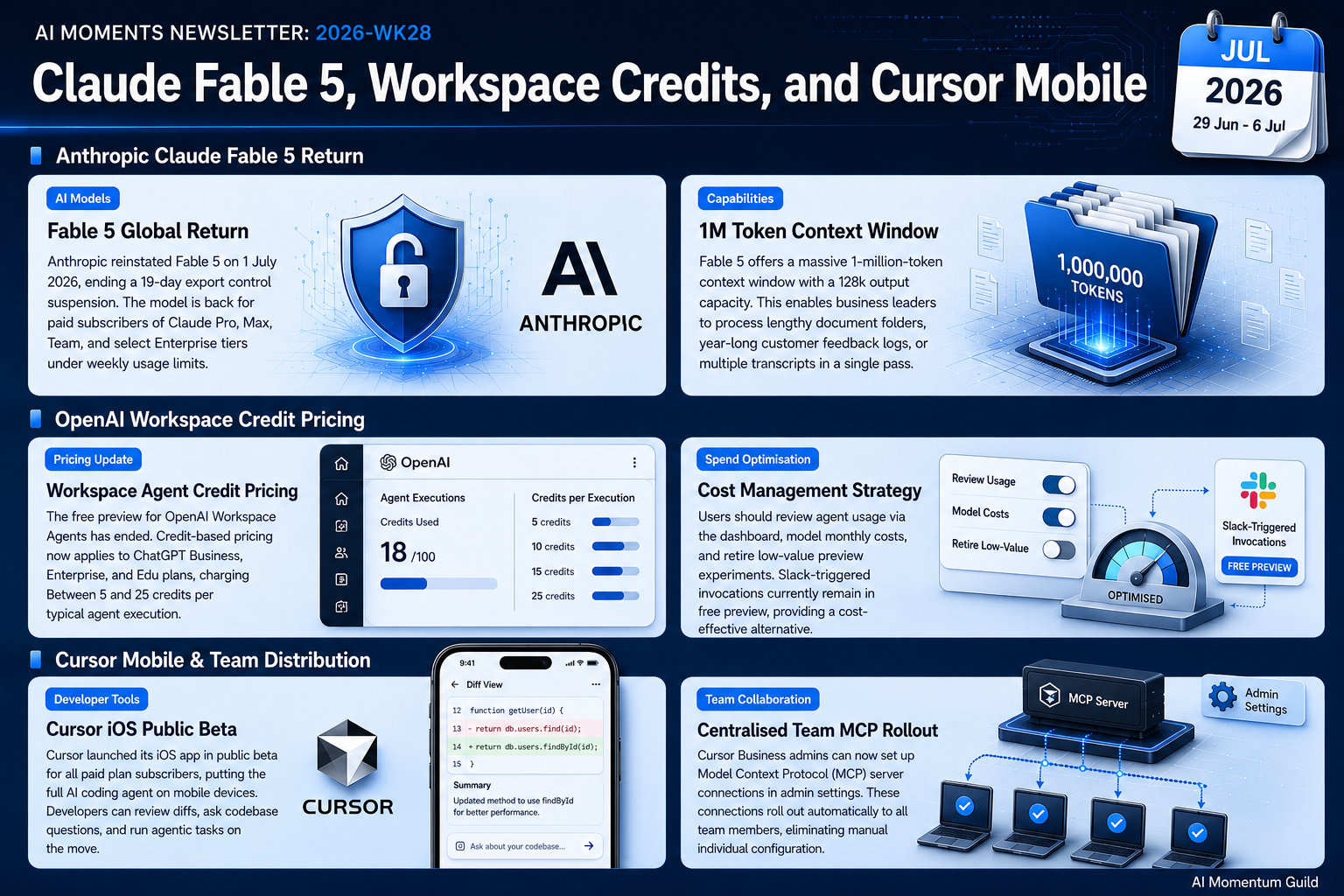
1. Claude Fable 5 returns globally after 19-day export control suspension
What changed
Anthropic reinstated Fable 5 on 1 July 2026, ending a 19-day suspension that ran from 12 to 30 June after US export control concerns. The suspension affected both Fable 5 and Mythos 5, though Opus 4.8 stayed available throughout, so most work carried on uninterrupted. It’s now back for Claude Pro, Max, Team, and select Enterprise subscribers within their weekly usage limits.
Why it matters
If you already pay for one of these plans, you’ve picked up Anthropic’s most capable model at no extra cost. Fable 5’s headline feature is a 1M token context window, roughly the length of three novels, with 128k output. In practice that means you can hand it a very long document, or a whole set of documents, and have it reason across the lot in one go rather than in fragments. Just note the usage shift: weekly limits allow up to 50% Fable 5 usage up to and including 7 July, after which it moves to credit-based usage. Also note, Fable 5 is very expensive to run, so it’s best reserved for genuinely complex work, orchestrating cheaper models to do the simpler parts.
How to use it
- Draft a full business plan from a folder of notes, financials, and market research in one pass
- Analyse an entire year’s worth of customer feedback or support tickets for recurring themes
- Research and summarise a long contract or supplier agreement, flagging clauses worth a second look
- Review a lengthy policy document against your own procedures to spot gaps
- Pull a coherent report out of several meeting transcripts without splitting them up
Source: Anthropic Blog
2. OpenAI Workspace Agents shifts to credit-based pricing as free preview ends
What changed
The preview period for OpenAI Workspace Agents ended today, 6 July 2026, and credit-based pricing now applies to agent runs inside ChatGPT: roughly 5 to 25 credits per typical run. This is available on Business, Enterprise, and Edu plans only, not Plus or individual plans, so it affects a subset of guild members rather than everyone. Workspace Agents can be handed tasks across Slack, Google Drive, Salesforce, Notion, and Atlassian tools.
Why it matters
If you’re on Business or Enterprise ChatGPT, you finally have real numbers to model your automation spend against. And if you’ve been leaning on Workspace Agents during the preview, now’s the moment to look at what you’ve actually been running and decide what’s worth keeping. One useful caveat: Slack channel invocations remain in free preview for now, so only in-ChatGPT runs carry the credit cost.
How to use it
- Open your usage dashboard and review which agents you’ve been running during the preview
- Model your likely monthly cost using the 5-to-25 credit range per run
- Identify the two or three automations delivering the clearest return and prioritise those
- Retire any preview experiments that aren’t earning their keep before costs start
- Keep Slack-triggered runs in mind as still in preview when planning workflows
Source: OpenAI Help Center | TechTimes
3. Cursor launches iOS public beta and team-wide MCP server distribution
What changed
Cursor made two separate announcements on 30 June, both useful for small teams. First, Cursor for iOS is now in public beta on the App Store for all paid plan subscribers, giving you the full coding agent on mobile: ask questions about code, review diffs, and run simple agents. Second, Cursor Business admins can now set up MCP server connections once in admin settings and have them roll out automatically to every team member, with no individual setup.
Why it matters
The iOS app means you can check in on a coding agent from anywhere, not just at your desk. And team MCP removes a real friction point for small dev teams. MCP (Model Context Protocol) is what lets an AI tool connect to your specific business systems, databases, APIs, and internal tools, and configuring it per person is fiddly. Now one admin does it once and the whole team is set up. Cursor featured last week too, but these are genuinely different features.
How to use it
- Review a coding agent’s changes from your phone whilst away from the desk
- Ask questions about a codebase on the move rather than waiting to get back
- Configure a shared database or API connection once and have every developer get it automatically
- Standardise which internal tools the AI can reach across your whole team
- Give one admin control of tool access for the team, which tidies up governance
Source: Cursor Changelog
Additional Noteworthy
Anthropic launches Claude Science for research laboratories: a specialist beta workbench aimed at pharmaceutical and academic labs rather than typical SME use. The application deadline is 15 July. | Anthropic Blog
California deploys Claude across all state agencies: the largest US government AI deal to date, which confirms Claude’s credibility at institutional scale. No direct SME action needed. | TechCrunch
Microsoft launches $2.5B ‘Frontier Company’ to embed AI engineers inside enterprise clients: targeting organisations like Unilever and LSEG. It’s a useful signal that implementation support, not just model access, is the real bottleneck for large enterprises. | Microsoft Blog
OpenAI previews GPT-5.6 Sol under US government access controls: no SME access currently, as it’s restricted to around 20 US-government-approved organisations under a June 2026 executive order. Worth monitoring for a future global release. | VentureBeat
Get in touch
Phone
+44 1865 57 59 55
Email he***@*********um.ai
Visiting Us
Oxford Digital Marketing Ltd
The Magdalen Centre
Oxford Science Park
Oxford
OX4 4GA
United Kingdom
Oxford Training Rooms
If you are attending a face-to-face training with us in Oxford
The Sadler Building
Oxford Science Park
Oxford
OX4 4GE