
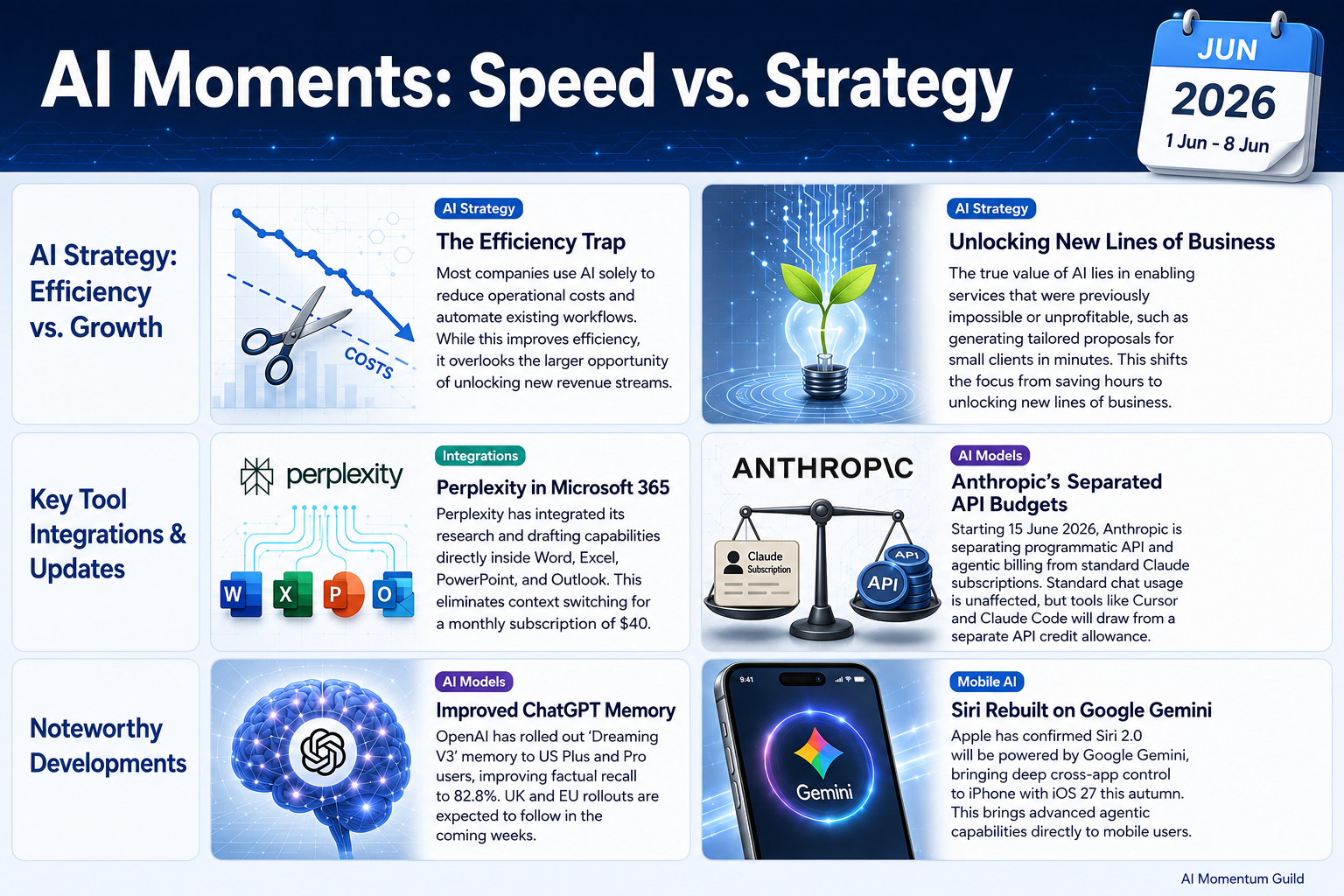
Research Period: 1 June to 8 June 2026
1. Most companies use AI to cut costs. The bigger prize is growth.
What changed
Three academics writing in Harvard Business Review (Shlomo Benartzi, Randall Long and Stefano Puntoni) make a pointed argument: almost every business reaches for AI to do the same things more cheaply. Fewer staff, faster processes, lower costs. They call this reflex badly misguided, not because efficiency is wrong, but because it quietly ignores the larger opportunity.
Why it matters
The distinction is easy to miss but worth sitting with. Using AI for efficiency means doing your existing work cheaper. Using AI for growth means doing things that simply were not possible before. Think of a two-person consultancy that has always turned away small clients because proper research and a tailored proposal took two days each. With AI doing the first draft of that research and proposal in an hour, those clients suddenly become worth taking. That is not the same job done cheaper. It is a new line of business that did not exist last year.
How to use it
- Where am I currently saying no to work because it is not worth the time, and could AI change that maths?
- What would I offer customers if research, drafting or analysis cost a tenth of what it does now?
- Am I measuring my AI projects only on hours saved, when I should also be asking what new revenue they could unlock?
- Which customer requests do I turn down today that AI might let me say yes to?
- If a competitor used AI to grow rather than to trim, where would they outflank me?
Source: Harvard Business Review
2. Perplexity research arrives inside Word, Excel, PowerPoint and Outlook
What changed
Perplexity has added its Computer integration to the main Microsoft Office applications. If you work in Word, Excel, PowerPoint or Outlook, you can now call on Perplexity’s research and drafting directly inside those programmes rather than switching to a separate browser tab. This requires a Perplexity Max subscription, which costs around $40 a month.
Why it matters
For members who live in Microsoft 365 all day, the friction of jumping between apps adds up. Having research and drafting where the work already happens removes a small but constant interruption. It is worth being honest about the cost: at roughly $40 a month, this is a paid tool for people who will use it regularly, not a casual add-on. If you only occasionally need AI research, you may not get the value. If drafting and research are a daily part of your job, the time saved can justify the spend.
How to use it
- Draft and refine documents in Word without leaving the page you are working on.
- Pull research summaries straight into a PowerPoint deck you are building.
- Analyse and explain spreadsheet data in Excel using plain-language questions.
- Summarise long email threads in Outlook before you reply.
- Test it for a month against your real workload before committing, so you can judge whether the $40 earns its place.
Source: VentureBeat, Perplexity Hub
3. Claude changes how it bills programmatic use — what to know before 15 June
What changed
From 15 June 2026, Anthropic is separating the billing pool for programmatic and agentic use of Claude. Until now, a Claude Pro or Max subscription let you use Claude through the API, Claude Code, the Agent SDK, or third-party tools such as Cursor as part of your subscription. From 15 June, that programmatic use draws from a separate pot of API credits charged at full API prices.
Why it matters
The new monthly credit allowances are: Pro ($20) gets $20 of API credits, Max 5× ($100) gets $100, and Max 20× ($200) gets $200. Heavy users can burn through those credits quickly, after which they pay standard API rates on top. The important point is who this affects. If you only use Claude through the normal chat interface or the app, nothing changes for you. This only touches people using Claude programmatically: through Claude Code, the Agent SDK, or third-party apps that route through the Claude API. For those users, it is a genuine cost increase, so it is worth checking your usage before the date rather than after.
How to use it
- Check whether you use Claude programmatically at all (Claude Code, Agent SDK, or tools like Cursor running on Claude).
- Review your current usage against the new credit allowance for your plan.
- Estimate your likely overage and decide whether to adjust your plan before 15 June.
- Confirm whether any team members or automations route through the Claude API on your account.
- Treat ordinary chat use as unaffected, so do not change anything if that is all you do.
Source: The Decoder, The New Stack
Additional Noteworthy
AI is rewriting the economics of outsourcing: Abhinav Agrawal argues in HBR that AI is automating the routine, rules-based work behind three decades of offshore savings. If you outsource anything repetitive, it is worth ten minutes. | Harvard Business Review
Big Tech faces a looming ‘capability debt’ crisis: A warning about cutting experienced engineers too fast. AI can automate output, but it cannot replace accumulated domain knowledge. Relevant to any SME weighing staffing decisions. | Harvard Business Review
ChatGPT ‘Dreaming V3’ memory launches in the US: OpenAI has improved ChatGPT memory for US Plus and Pro users, updating what it knows about you from your conversations with 82.8% factual recall. No confirmed UK or EU date yet, but rollouts usually follow within weeks. | OpenAI
Microsoft Build previews Scout agent and MAI models: Scout is an always-on M365 agent that can attend meetings, draft responses and manage scheduling, alongside seven new in-house MAI models. Scout is in customer preview, not yet generally available, but worth watching if you rely on Microsoft 365. | Microsoft
Apple WWDC 2026: Siri rebuilt on Google Gemini: Apple has confirmed Siri 2.0 will run on Google Gemini, bringing a genuinely useful, cross-app Siri to iPhone with iOS 27 this autumn at no extra cost. One to watch, not one to act on today. | Apple
Looking Ahead
Watch for ChatGPT Dreaming V3 reaching the UK in the coming weeks. Worth noting too: Anthropic filed a confidential S-1 with the SEC on 1 June at a $965B valuation, which is not actionable for members but suggests the company’s long-term stability looks assured.
This briefing covers AI developments relevant to SME operations from 1 June to 8 June 2026.