
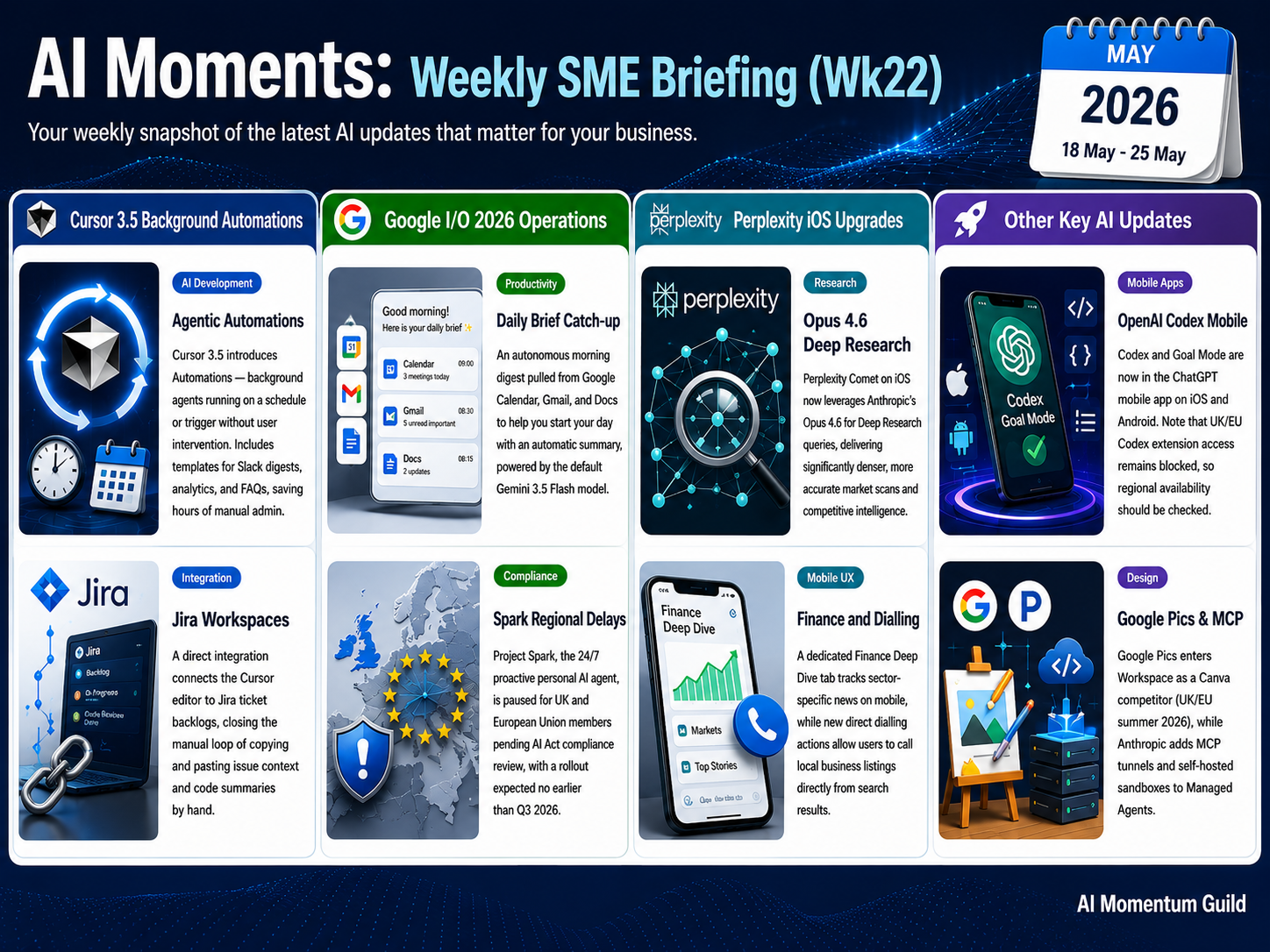
Research Period: 18 May 2026 to 25 May 2026
1. Cursor 3.5: Automations, Jira integration, and a smarter Composer
What changed
Cursor pushed three releases in three days. Composer 2.5 (18 May) is the new base model for agentic tasks. Jira integration (19 May) connects the editor to your ticket backlog. Cursor 3.5 (20 May) introduces Automations: background agents that run on a schedule or trigger without anyone sitting at the keyboard. Automations now support multiple repositories and ship with five marketplace templates: Slack digest, product analytics, FAQ updater, financial reporting, and customer health.
Why it matters
Until now, AI coding assistants needed a developer driving them. Automations turns that on its head. You can set an agent to summarise pull requests into a Slack channel every morning, regenerate your FAQ from support tickets overnight, or rebuild a financial dashboard on a Friday afternoon. The Jira loop closes a gap many of us have been bridging by hand: pasting tickets into prompts and pasting code summaries back. For small teams without a dedicated devops engineer, that’s two or three hours a week back.
How to use it
- Set a nightly Automation to summarise customer support tickets and post key themes to Slack
- Run a weekly Automation that updates your product FAQ from recent ticket resolutions
- Schedule a Friday Automation to draft a financial reporting summary across your repositories
- Connect Jira to Cursor so issue context flows directly into your coding sessions
- Use the customer health template to flag at-risk accounts based on usage signals each Monday
Source: Cursor 3.5 changelog (cursor.com). Globally available. Cursor Pro is around $20 per month. Jira integration needs Jira Commercial Cloud with Rovo enabled.
2. Google I/O 2026: Gemini 3.5 Flash, Daily Brief, and an agent UK members can’t use yet
What changed
Google I/O brought over 100 announcements on 19 May. Three matter for SME operations. Gemini 3.5 Flash is now the default model behind Google AI applications, faster and noticeably better than its predecessor. Daily Brief delivers an autonomous morning digest pulled from your calendar, inbox, and documents: no prompt required. Project Spark, Google’s 24/7 proactive personal AI agent, was the headline announcement but is in beta for US Google AI Ultra subscribers only.
Why it matters
Daily Brief is the practical win. Most of us spend the first hour of the day catching up: Daily Brief writes that catch-up for you and has it waiting when you open Gemini. It runs on the new 3.5 Flash model so responses feel snappier across the board. Spark, sadly, is a hard stop for UK and EU members. Google has paused its launch pending AI Act compliance review, with Q3 2026 the earliest realistic date. Don’t plan around Spark; do plan around Daily Brief if you already pay for Google AI.
How to use it
- If you have Google AI Plus, Pro or Ultra, enable Daily Brief and let it write your morning digest
- Notice the speed improvement in Gemini 3.5 Flash for everyday Workspace queries and document drafts
- Test Neural Expressive in Gemini for more natural voice output during dictation
- Audit your Workspace subscription: standard Business plans may not include the Google AI tier required for Daily Brief
- Bookmark Spark coverage for a Q3 2026 review; do not build it into current workflows
Source: Sundar Pichai’s I/O 2026 keynote summary (blog.google). Daily Brief and Gemini 3.5 Flash are globally available on the right subscription tiers.
3. Perplexity Comet for iOS: eight improvements and Opus 4.6 powering Deep Research
What changed
Perplexity shipped eight improvements to its Comet browser on iOS on 21 May. Deep Research now runs on Anthropic’s Opus 4.6 model, a meaningful step up in quality for long-form research tasks. Finance Deep Dive has its own dedicated tab. Search results now include phone-number actions: tap a business listing and you can ring them directly from the result.
Why it matters
Deep Research on Opus 4.6 is the headline. If you’ve used Perplexity for market scans, supplier shortlists or competitive intelligence, the answers should now be denser and more accurate. Finance Deep Dive is a small but well-targeted addition for owners tracking financial news on their phone. Tier matters here: Perplexity Max subscribers get Opus 4.6 immediately, whilst Pro subscribers receive it through a gradual rollout. If you’re on Pro and don’t see Opus 4.6 yet, give it a fortnight.
How to use it
- Run a Deep Research query on a competitor or supplier and compare the depth to your previous results
- Use Finance Deep Dive to track sector news relevant to your customers each morning
- Call a local business directly from Comet’s search results when sourcing or doing supplier checks
- If you’re a Pro subscriber, check whether Opus 4.6 has rolled out before judging Deep Research quality
- Consider Perplexity Max (roughly £17–19 per month) if Deep Research is central to your workflow
Source: Perplexity Comet iOS update (9to5Mac). Globally available in the UK, EU, Africa and India.
Additional Noteworthy
OpenAI Codex on mobile, Goal Mode generally available: Codex now runs in the ChatGPT mobile app on iOS and Android, and Goal Mode is out of preview. UK and EU availability of Codex specifically is unconfirmed — the Codex Chrome extension was blocked in those regions on 8 May, so check before relying on it. | TechCrunch
Google Pics arriving in Workspace: Google announced an AI design tool aimed squarely at Canva, bundled into Workspace. UK availability isn’t expected before summer 2026, so this is one to watch rather than act on. | Google blog
Anthropic MCP tunnels and Code with Claude London: Anthropic added MCP tunnels and self-hosted sandboxes to its Managed Agents offering. More relevant for developers, but worth flagging the Code with Claude London event on 28 May for technically inclined members. | Anthropic news
Datasette Agent from Simon Willison: A new open-source AI assistant that translates natural language into SQL against a Datasette database. Useful if you have an operational database and are tired of waiting for IT to run reports. | Simon Willison’s blog
Spotify AI Studio and ElevenLabs audiobooks: Spotify launched an AI content creation studio plus an ElevenLabs-powered audiobook tool. Niche, but relevant if you publish podcasts or audio content as part of your marketing. | TechCrunch
Looking Ahead
Watch for confirmation on whether OpenAI’s Codex tools are available in the UK and EU — if they are, expect Codex on mobile to climb up next week’s list. Keep an eye on Google Pics for an EU rollout date, and on Spark when AI Act compliance closes.
This briefing focuses on AI developments relevant to SME operations. We pick three items each week that you can actually use, with a handful of others worth knowing about. Reply with anything you’d like covered next week.