
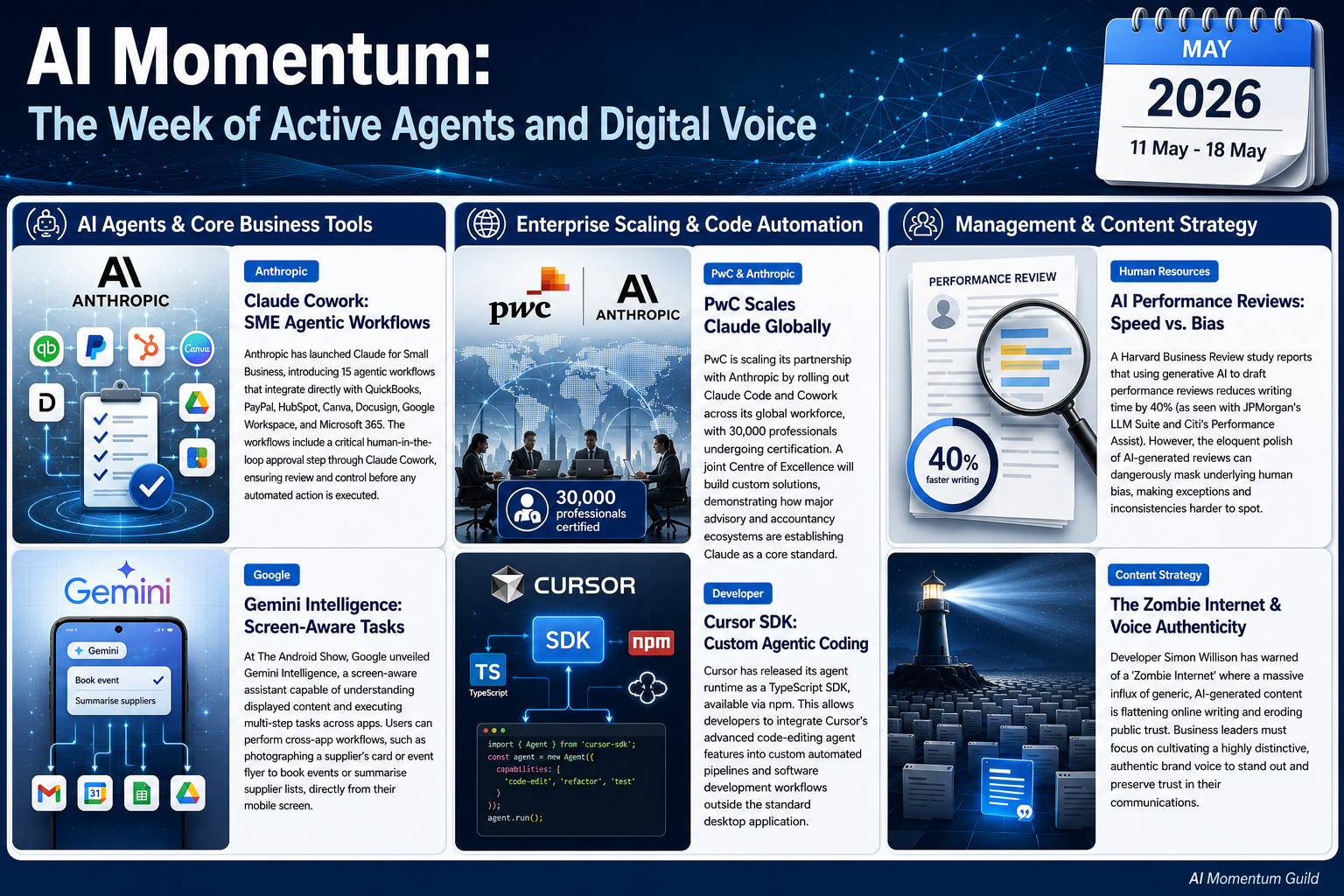
Research Period: 11 May 2026 to 18 May 2026
Please check the infographic below.
Please review the slide version of the newsletter: view slides linked here.
1. Claude for Small Business: 15 ready-to-run workflows in the tools you already use
What changed
Anthropic launched Claude for Small Business on 13 May, a package of 15 agentic workflows that plug directly into QuickBooks, PayPal, HubSpot, Canva, Docusign, Google Workspace, and Microsoft 365. Workflows cover finance, operations, sales, marketing, HR, and customer service. Everything runs through Claude Cowork with a human-in-the-loop approval step: you initiate the task, Claude shows you its plan, and nothing happens until you approve.
Why it matters
This is the first credible attempt to deliver agentic AI to SMEs without forcing a software change. If you already use QuickBooks for your books or HubSpot for your pipeline, the workflows sit inside those tools and respect their permissions. The approval step matters too: it means you can start in review mode and only graduate to faster automation once you trust the output for a specific task.
How to use it
- Draft payroll planning and cash-flow forecasts inside QuickBooks
- Run a monthly close with reconciliation prompts and exceptions flagged
- Build and launch HubSpot sales campaigns with approval gates
- Track invoices and chase overdue payments through PayPal
- Generate Canva marketing assets tied to specific campaigns
Source: Anthropic announcement
Worth knowing: this requires a Claude Max subscription (around £100 per month) and the 10-city launch roadshow is US-only, though the product itself is available globally. Start with one workflow in review-and-approve mode before considering anything closer to full automation.
2. Google Gemini Intelligence: proactive AI that reads your screen
What changed
At The Android Show on 12 May, Google unveiled Gemini Intelligence: not just another assistant, but a system that understands what’s on your screen and completes multi-step tasks across apps. Photograph an event flyer and Gemini can find and book it. Show it a grocery list and it builds the shopping cart. Google also previewed Googlebooks, a new AI-native laptop category launching autumn 2026 with Acer, Asus, Dell, HP, and Lenovo. Google I/O 2026 is on 19 May with a new Gemini model expected.
Why it matters
For SME owners running their business from a phone, this shifts what’s possible without opening five apps. The cross-app context awareness is the meaningful part: it means a screenshot or a photo can become a completed task rather than a starting point. Worth watching closely if Android is your daily driver, and worth a longer think before any hardware refresh given Googlebooks is on the way.
How to use it
- Photograph a business card or supplier flyer and have Gemini action it
- Summarise long documents or email threads visible on screen
- Cross-app scheduling from a single conversation
- Page summarisation in Chrome for Android while researching suppliers
- Hands-free workflows in Android Auto for sales calls between meetings
Source: Google blog post | TechCrunch summary
Important caveat: if you use Google Workspace for business, Gemini Intelligence may not be available on your work account. Personal Google accounts are confirmed, but Workspace admin settings can restrict consumer Gemini features. Check before assuming you’ll see it.
3. Performance reviews with AI: 40% faster, but watch the bias
What changed
A Harvard Business Review analysis published this week reports that enterprises using generative AI to draft performance reviews are cutting writing time by roughly 40% (the figure draws on BCG internal data, with Citi’s Performance Assist and JPMorgan’s LLM Suite cited as examples). The catch: AI-polished reviews feel more authoritative and consistent than they actually are. The concern isn’t that AI gets the words wrong; it’s that the polish hides the same inconsistencies and blind spots that human managers have always had, only now they’re harder to spot and challenge.
Why it matters
If you run a formal review cycle, this is genuinely useful: drafting time drops noticeably and you can spend more energy on the substance. But the risk is real. A well-written review that says very little, or that quietly reflects a manager’s bias, can pass as fair simply because it reads well. Treat the output as a first draft, not a final answer.
How to use it
- Draft your next review with Claude or ChatGPT using your bullet-point notes
- Use AI to pull together evidence (email threads, completed work) rather than just polish prose
- Ask the AI to identify what’s missing or vague before you finalise
- Run a “bias gap” check: does the draft actually reflect your assessment?
- Build a review template in your existing AI subscription rather than buying a new tool
Source: HBR article
Worth knowing: the 40% figure comes from enterprise deployments with thousands of reviewers, so SME results will vary. The substantive point — that polish can mask weak thinking — applies at any size.
Additional Noteworthy
Anthropic and PwC scale up: PwC is rolling out Claude Code and Cowork across its global workforce, with 30,000 professionals being certified and a joint Centre of Excellence established. The strategic signal: if your advisors, accountants, or consultants are part of the Big Four ecosystem, Claude is becoming their standard tool. | Read more
Cursor TypeScript SDK: Cursor now exposes its agent runtime as a TypeScript SDK, so developers can build custom automated coding workflows beyond the desktop app. Token-based pricing, npm install @cursor/sdk. Worth a look if you work with a developer or have someone technically confident on the team. | Read more
The Zombie Internet: Simon Willison flags a growing problem: AI-generated content isn’t only proliferating, it’s shaping how humans write, making information filtering exhausting and eroding trust. If you create content with AI, a distinctive authentic voice matters more than ever. | Read more