
Research Period: 2026-04-27 to 2026-05-04
1. Anthropic launches Claude for Creative Work
What changed
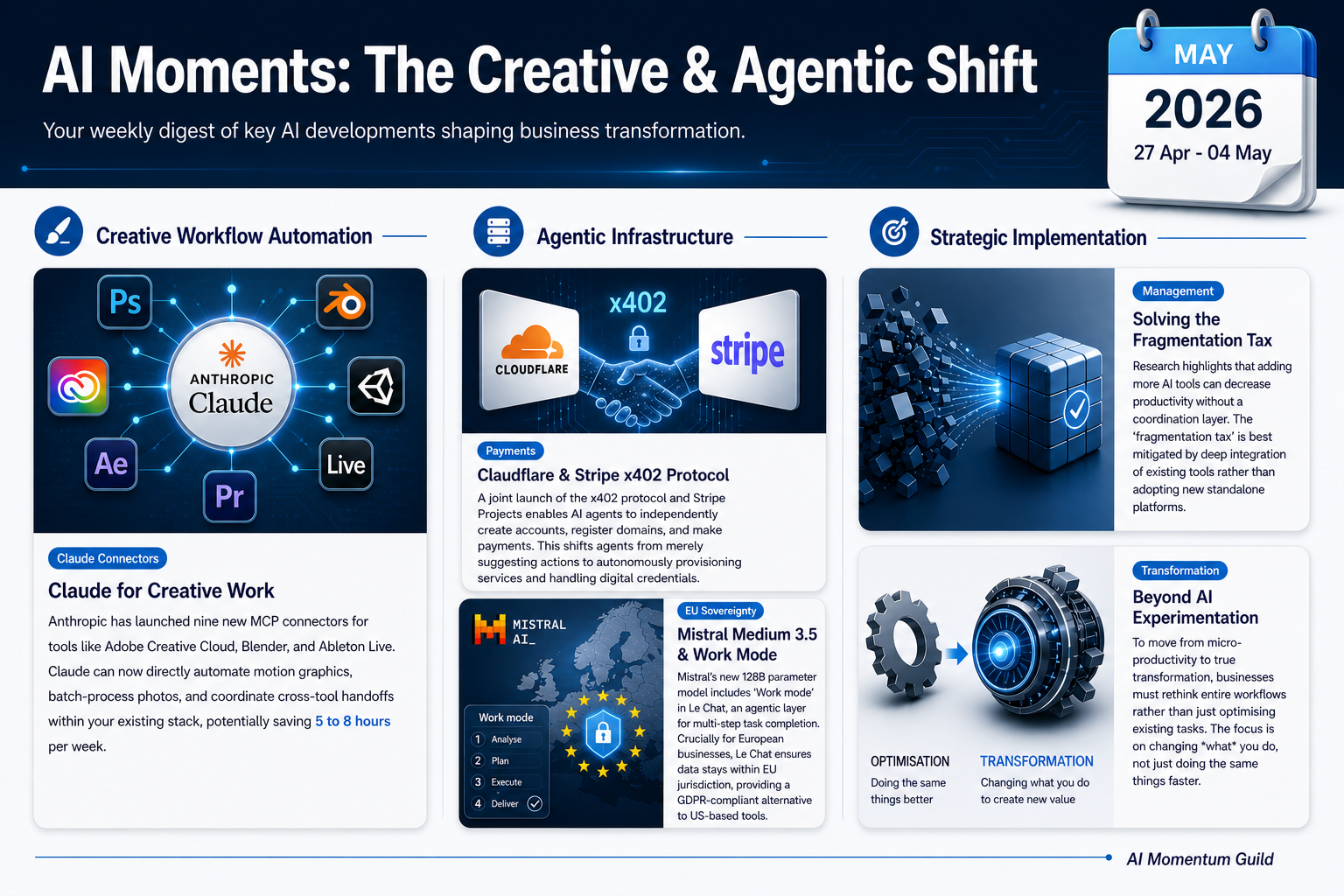
Anthropic has shipped nine new MCP connectors that let Claude work directly inside the creative applications you may already use. The list covers Adobe Creative Cloud, Blender, Ableton Live, Unity, and five others. Instead of copy-pasting between Claude and your design or audio tools, Claude can now generate scripts, batch-process assets, and handle handoffs between applications without you leaving your workflow.
Why it matters
This is the moment Claude stops being a separate chat window and starts behaving like a workflow engine plugged into your creative stack. For SMEs in marketing, design, video, audio, or content production, the time saving is meaningful: early users report 5 to 8 hours a week back on repetitive production tasks. There is no extra cost if you already pay for Claude Pro, Max, Teams, or Enterprise. Setting up the connectors does take a bit of fiddling; count on 30 to 60 minutes for the first one.
How to use it
- Generate Adobe After Effects scripts to automate repeated motion-graphics edits across a campaign
- Batch-rename, resize, and re-export hundreds of product photos through Photoshop without manual clicking
- Build a Blender scene from a written brief, then ask Claude to iterate on materials and lighting
- Hand off a brief from Claude into Ableton to sketch a podcast intro or background track
- Co-ordinate cross-tool handoffs (for example, Figma export to Photoshop retouch to InDesign layout) in a single conversation
Source: Anthropic Blog
2. Cloudflare and Stripe launch a protocol for AI agents that can pay and provision
What changed
Cloudflare and Stripe have jointly launched the x402 protocol and Stripe Projects, opening up infrastructure where AI agents can create accounts, register domains, deploy applications, and make payments without a human clicking “approve” each time. It is in open beta now. Think of it as an AI agent walking into the digital high street with its own debit card and credentials.
Why it matters
For most guild members this is not something to implement this month. It is, however, important to understand the direction. Until now, AI agents could draft an email but could not actually buy the stamp. With x402 and Stripe Projects, agents can independently provision the cloud services they need to do their work. The shift from “agent suggests, human pays” to “agent does, then reports back” is closer than most people realise. Implementing it today requires real developer skills. The technically inclined members of your team or network might be worth pointing at Stripe Projects to experiment in a sandbox.
How to use it
- Read the Stripe Projects documentation to understand what guardrails and spending limits are possible
- If you have a developer on the team, ask them to spin up a sandbox account and try one low-stakes scenario
- Update your internal AI policy to address: who can authorise an agent to spend money, and up to what limit
- Watch how agencies and competitors deploy this — the early movers will surface the practical patterns
- Add x402 and Stripe Projects to your “things to revisit in six months” list
Source: Cloudflare Blog
3. Mistral launches Medium 3.5 with Work mode in Le Chat
What changed
Mistral, the French AI lab, has released Medium 3.5, a 128 billion parameter model, and added Work mode to Le Chat, their consumer chat product at chat.mistral.ai. Work mode acts as an agentic task-completion layer: give it a multi-step job and it will plan, execute, and report back. The model is available with open weights on Hugging Face, and Le Chat itself is accessible without any developer skills.
Why it matters
If you are already happy with Claude or ChatGPT, you do not need to switch. The real value here is for European businesses worrying about data sovereignty: Mistral is EU-headquartered, and Le Chat keeps your data inside European jurisdiction. That matters if you handle GDPR-sensitive work or have clients in regulated sectors. The wider point: the open-source field is catching up, and a credible European alternative is now genuinely usable by non-technical staff. It is a viable second tool, not a replacement for what you already pay for.
How to use it
- If you are in a regulated sector (legal, healthcare, financial services), trial Le Chat for the work where data location matters
- Compare a multi-step task, such as drafting a proposal or summarising a long document, between Claude and Le Chat Work mode and judge the quality difference for your use cases
- For European clients who ask “where does my data go”, Le Chat gives you a clear answer
- If you have a developer team, the open-weight model on Hugging Face is worth a look for self-hosted scenarios
- Treat Mistral as a benchmark: its progress tells you how fast the open-source side is closing the gap
Source: Mistral AI Blog
Additional Noteworthy
HBR — psychological costs of AI adoption: Survey of 1,200 employees finds anxiety and performance pressure can wipe out the productivity gains AI delivers; introduce tools transparently, explain why, and build in support. | Harvard Business Review
UK AISI — GPT-5.5 cyber capabilities: The UK AI Security Institute confirmed GPT-5.5 can autonomously execute corporate network attacks in lab conditions (71.4% pass@1, 2 of 10 attempts succeeded end-to-end). Practical step: review your MFA, patching, and monitoring — the bar for what attackers can attempt has just risen. | UK AI Security Institute
Google I/O 2026 confirmed for 19-20 May: Expect Gemini 4 and Android 17 announcements, with meaningful Workspace and Gemini updates likely; the livestream is open to anyone. | Google Developers Blog
OpenAI Codex CLI adds /goal command: Developer-only feature in Codex CLI v0.128.0 that sets persistent objectives across coding sessions; relevant if your team already uses Codex CLI. | OpenAI Codex GitHub
Cursor ships Security Review agents and team marketplace: Cursor’s Teams plan now includes agents that automatically scan pull requests for vulnerabilities, plus a plugin marketplace for sharing internal tools — relevant if your team builds software with Cursor. | Cursor Changelog
Strategic Awareness
These two pieces of research, taken together, make a strong case for depth over breadth in your AI tooling.
- Atlassian — State of Teams 2026 (the “fragmentation tax”): A survey of 5,000+ knowledge workers found that more AI tools are making teams less productive, not more, when there’s no coordination layer underneath. They’ve coined this the “fragmentation tax” — the hidden overhead of managing many disconnected AI tools. The fix isn’t another tool; it’s better integration of the ones you have. | Atlassian
- HBR — moving from AI experimentation to AI transformation: A Bain and OpenAI economist analysis argues that most companies are stuck in a “micro-productivity trap” — using AI to do the same tasks faster instead of rethinking what those tasks are. Optimising means quicker typing and faster searches. Transforming means changing what you actually do day to day. Most SMEs are still in the trap. | Harvard Business Review
The takeaway for the guild: this is why something like Anthropic’s creative connectors matters more than yet another standalone tool. One AI properly integrated into your workflow beats five loosely used ones — every time.
Looking Ahead
Google I/O on 19-20 May will likely bring Gemini 4 and meaningful Workspace updates — we’ll cover what matters for SMEs in an upcoming newsletter. The EU AI Act Omnibus third trilogue is on 13 May, with compliance deadline clarity expected for European businesses. And keep an eye on the Cloudflare/Stripe x402 protocol — more accessible tooling built on this infrastructure is likely over the coming months.
This briefing focuses on AI developments relevant to SME operations, with emphasis on practical implementation, business impact, and tools accessible to non-technical users.