
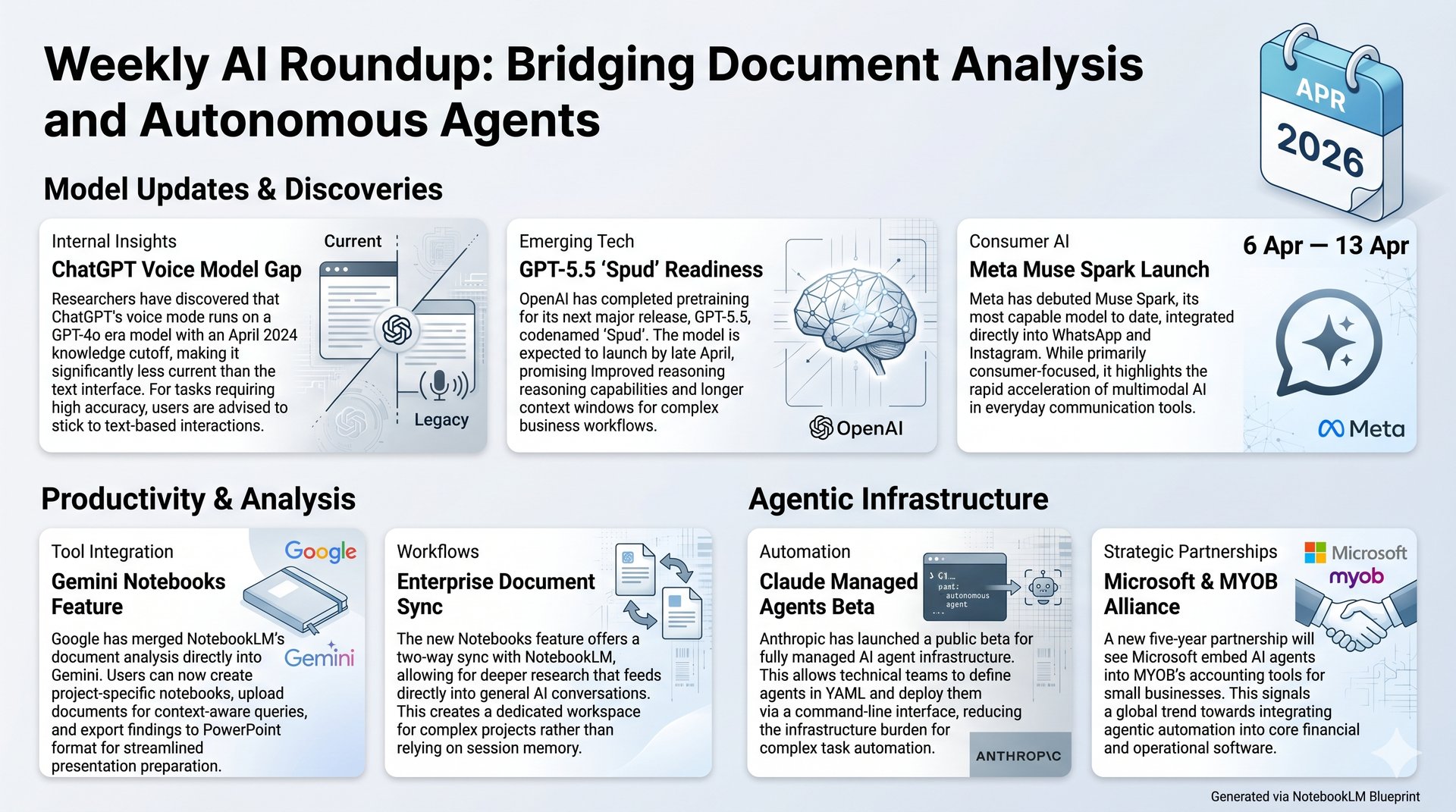
Research Period: 6 April to 13 April 2026
1. ChatGPT voice mode quietly runs on a much older, weaker model
What changed
Simon Willison, a respected AI researcher and developer, discovered that ChatGPT’s voice mode runs on a GPT-4o era model with an April 2024 knowledge cutoff — over two years behind the text interface. OpenAI’s text-based ChatGPT uses their latest models with current knowledge, but when you switch to voice, you’re talking to something substantially less capable. There’s no disclosure of this in the ChatGPT interface. Most users have no idea they’re getting different quality depending on how they interact.
Why it matters
If you or your team use ChatGPT voice mode for anything important — drafting client responses, researching suppliers, checking technical details — you may be getting outdated or less accurate answers without realising it. The practical fix is simple: use text mode for queries where accuracy matters, and treat voice mode as a convenience for casual tasks like brainstorming or dictation. This is also a useful reminder to verify which model version any AI tool is actually running — the interface doesn’t always tell you. Worth a quick team conversation if voice mode has become part of your workflow.
How to use it
- Switch to text mode when researching current market conditions or competitor activity
- Use voice mode for brainstorming and initial idea generation where precision matters less
- Verify important voice-mode answers by re-running the same question in text mode
- Brief your team on the difference so nobody relies on voice for client-facing work
- Check model version details in AI tool settings before building voice into a business process
Source: Simon Willison’s Blog
2. Google integrates NotebookLM into Gemini with new Notebooks feature
What changed
Google has merged NotebookLM’s document analysis capabilities directly into the Gemini app through a new ‘Notebooks’ feature. You can now create topic-specific notebooks within Gemini, upload documents, PDFs, and web links, then set custom instructions for how the AI should work with that material. Notebooks sync two ways with NotebookLM and can generate study guides, infographics, audio and video overviews, and export to PowerPoint format. Think of it as giving Gemini a focused workspace for each project rather than one long conversation.
Why it matters
This brings genuine document analysis into the same interface where many people already use Gemini for general queries. For businesses that regularly work with reports, contracts, or technical documents, having a dedicated notebook per project — with its own context and instructions — is more practical than copying text into chat windows. The export to PowerPoint alone could save hours of presentation preparation. Important caveat: this is currently available only on personal Google accounts with an AI Ultra, Pro, or Plus subscription. If your business runs on Google Workspace, you cannot access this yet. Google says Workspace rollout is coming ‘in the coming weeks’ but has not confirmed a date. UK and European availability is also listed as ‘coming weeks’, not confirmed.
How to use it
- Create a notebook per client project and upload all relevant documents for quick AI-assisted reference
- Generate presentation slides from meeting notes or project briefs using the PowerPoint export
- Build a notebook for onboarding new staff — upload policies, procedures, and guides in one place
- Produce audio summaries of long reports for listening during commutes
- Set custom instructions per notebook so the AI understands your industry terminology and preferences
Source: Google Blog | Android Authority
3. Anthropic launches Claude Managed Agents public beta
What changed
Anthropic has launched a public beta for Claude Managed Agents — fully managed AI agent infrastructure that runs on Anthropic’s platform. The key tool is ant, a command-line interface where developers define agents in YAML configuration files and deploy them without building their own hosting or orchestration. Pricing is $0.08 per session hour plus standard API token costs. Launch partners include Notion, Rakuten, and Sentry, giving some indication of the scale Anthropic is targeting. This is a public beta, meaning it’s available to try but still evolving.
Why it matters
Until now, building AI agents that can take multi-step actions — research a topic, draft a document, send an email — required significant technical infrastructure: hosting, error handling, state management, security. Anthropic is offering to handle all of that. Honest note: this is aimed at developers and technical teams. If your business has in-house developers or works with a development agency, this lowers the barrier to building custom AI agents for your specific workflows. For most guild members, this is more about understanding where the industry is heading than something to implement this week. The pricing model — pay per session hour rather than per seat — is worth noting as a pattern we’ll likely see more of.
How to use it
- Ask your development team to evaluate whether custom agents could automate repetitive business processes
- Compare the per-session-hour pricing against building and hosting your own agent infrastructure
- Explore YAML agent definitions as a low-code way to prototype automation ideas
- Monitor launch partner case studies (Notion, Sentry) for practical examples of agent deployments
- Track this as a signal of where AI tooling is heading: from chatbots to autonomous task completion
Source: SiliconANGLE | The New Stack
Additional Noteworthy
Meta launches Muse Spark, its most capable AI model: Powers the Meta AI app across WhatsApp, Instagram, and Facebook. Impressive technology, but this is a consumer platform play rather than a business tool. Worth knowing about if your team uses Meta’s platforms for customer communication. | TechCrunch
OpenAI GPT-5.5 ‘Spud’ pretraining complete: Polymarket gives 78% odds of release by 30 April. No confirmed capabilities yet, but if it follows the pattern of previous releases, expect improved reasoning and longer context windows. One to watch for next week’s newsletter. | Prime AI Center
Microsoft and MYOB sign five-year AI partnership for ANZ small businesses: Microsoft will embed AI agents into MYOB’s accounting tools, serving 3.28 million small businesses in Australia and New Zealand. ANZ-only for now, but signals the direction for AI-powered accounting tools globally. | Microsoft
Looking Ahead
A quieter week for immediately actionable developments, but two Harvard Business Review articles are worth your time. The first argues that layering AI on top of broken processes just makes problems worse faster — fix your foundations (clear workflows, good data, defined responsibilities) before adding AI to the mix (read it here). The second highlights that cyber risk is shifting from an IT department problem to a board-level governance issue, particularly as AI tools handle more sensitive business data. Both are practical reads rather than theory. Separately, keep an eye on OpenAI — if GPT-5.5 does land before the end of April, it could reshape what’s possible with their tools. And Anthropic’s Claude Mythos model (currently restricted access) continues to generate discussion about AI regulation and safety frameworks. More on both if they develop.
This briefing focuses on AI developments relevant to SME operations. It prioritises tools and features from established providers that UK-based businesses can act on today, with clear notes where geographic restrictions or technical prerequisites apply.