
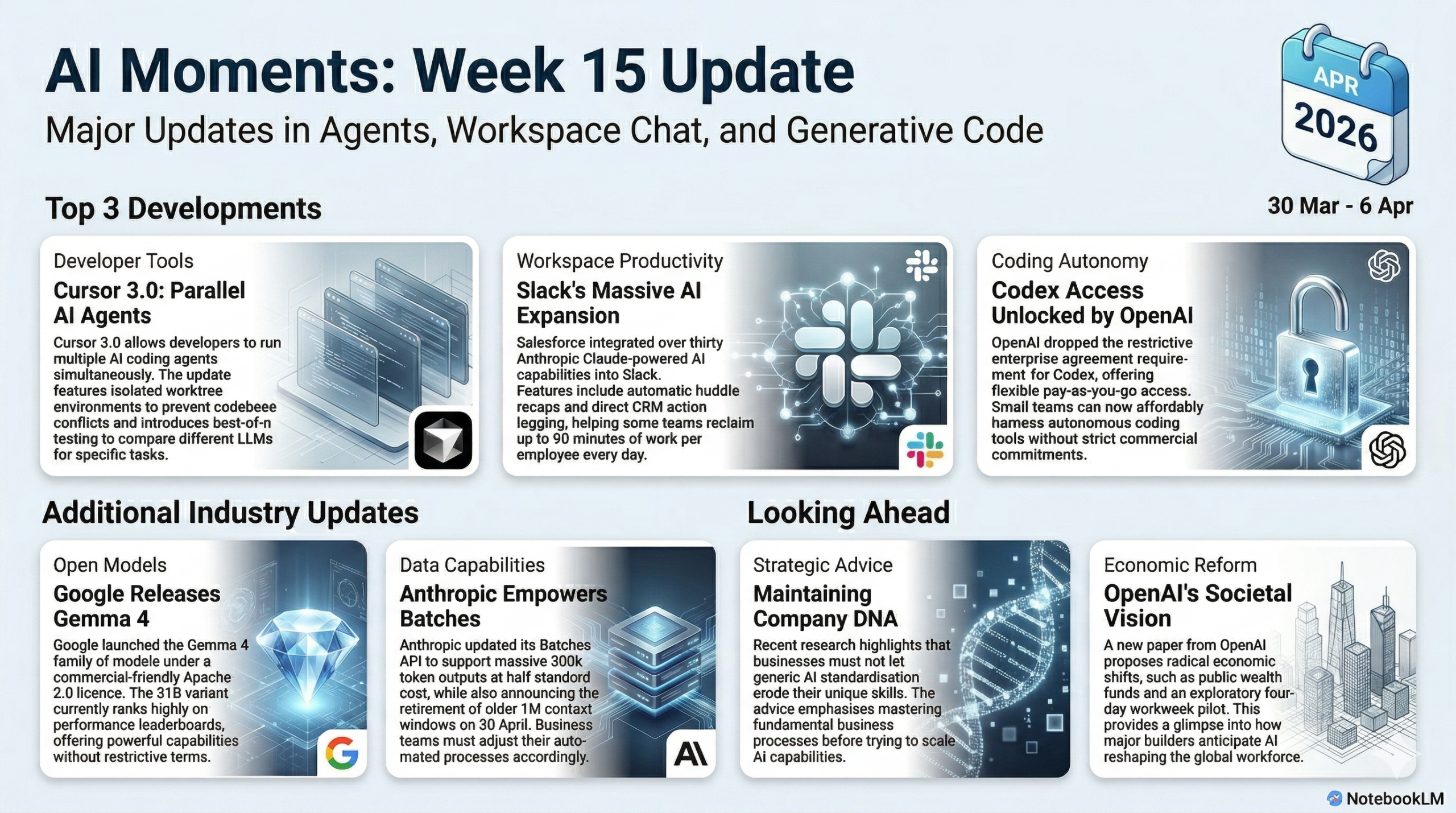
Research Period: 30 March to 6 April 2026
1. Cursor 3.0 — run multiple AI coding agents at the same time
What changed
Cursor, the AI-powered code editor, released version 3.0 with a major new capability: parallel AI agents. Instead of giving your AI assistant one task and waiting for it to finish before starting the next, you can now run several agents simultaneously, each working on a different part of your codebase. A new /best-of-n command lets you run the same task across multiple AI models and compare their outputs before committing to one. There’s also /worktree, which gives each agent its own isolated workspace so they can’t interfere with each other, and a Design Mode for UI work. Available now to Cursor Pro and Business subscribers (approximately $20/month).
Why it matters
Think of it as going from having one assistant who handles tasks sequentially — finish this, then start that — to having three assistants working on different rooms of the house at the same time. For development teams, this is a genuine productivity multiplier. The /best-of-n feature is particularly clever: if you’re unsure which AI model handles a particular problem best, you can pit them against each other and pick the winner. Honest note: this is squarely aimed at teams with active software development work. If your business doesn’t write code, this one’s more “interesting to know about” than immediately useful.
How to use it
- Run one agent on front-end styling while another tackles back-end logic simultaneously
- Compare outputs from Claude, GPT, and Gemini on the same coding problem using
/best-of-n - Give each developer on your team their own parallel agent for independent feature work
- Use
/worktreeto test risky changes in isolation without affecting the main codebase - Assign repetitive refactoring to a background agent while you focus on new feature design
Source: Cursor Changelog
2. Slack adds 30 AI features — employees saving up to 90 minutes a day
What changed
Salesforce has added 30+ AI features to Slackbot, all powered by Anthropic’s Claude. The headline additions include meeting intelligence (automatic recaps and action item capture from Huddles), CRM automation (log customer conversations directly from Slack channels), and reusable AI Skills that teams can create once and share across the whole workspace. These features require Slack Business+ (approximately £10–13/user/month) or Enterprise Grid.
Why it matters
The numbers here are worth pausing on. Salesforce reports that customers including Anthropic and Wayfair are seeing up to 90 minutes saved per employee per day. Run that forward: for a 10-person team, that’s roughly 250 hours reclaimed every month, the equivalent of adding 1.5 full-time staff without hiring anyone. Salesforce themselves report 20 hours saved per week internally, translating to £6.4M in productivity gains. Even if your team sees half that benefit, the maths is compelling. Honest note: you’ll need Business+ or higher. If you’re on Slack’s standard paid plan, this means an upgrade. Worth calculating whether the time savings justify the per-seat cost for your team size.
How to use it
- Automatically capture action items from Slack Huddles and post them to the relevant channel
- Log client conversations from Slack directly into your CRM without switching apps
- Create a reusable AI Skill for drafting weekly status updates from channel activity
- Summarise long threads into key decisions so team members who missed the conversation can catch up quickly
- Build a custom Slackbot workflow that pulls project data and formats it into client-ready reports
Source: TechCrunch
3. OpenAI opens Codex to any team — no enterprise contract required
What changed
OpenAI has removed the enterprise agreement requirement from Codex, its autonomous coding tool. Previously, getting access meant signing a corporate contract, a barrier that effectively locked out small teams. Now any team can add members with no fixed seat fee; you pay only for what you use (token-based billing). There are no rate limits for Codex-only seats. The growth numbers tell the story: 2 million developers use Codex weekly, up five-fold in three months, with 70% month-over-month growth.
Why it matters
This is a straightforward access story. Codex can work autonomously on coding tasks: you describe what you need, it writes and tests the code in a sandboxed environment, then presents the result for your review. Until now, that capability required an enterprise relationship with OpenAI, which meant minimum commitments and procurement cycles that don’t suit a five-person development shop. The pay-as-you-go model means a solo developer or small agency can start with one seat and scale based on actual usage. Most relevant for businesses with in-house developers or technical founders who code.
How to use it
- Assign a bug fix to Codex and review the tested solution rather than debugging manually
- Use Codex to write test suites for existing code: describe the expected behaviour and let it generate tests
- Start with a single developer seat to evaluate before rolling out to the wider team
- Delegate boilerplate code generation (API integrations, database migrations) to free up developer time for complex work
- Compare Codex outputs with Cursor’s parallel agents to find the best tool for your team’s workflow
Source: OpenAI Blog
Additional Noteworthy
Google releases Gemma 4 — most capable open models under Apache 2.0 licence: Four model sizes with the 31B variant ranking #3 globally on Arena AI. Apache 2.0 means no restrictions on commercial use — relevant for businesses building AI into their own products. Testable now via Google AI Studio. | Google Blog
AI enables qualitative customer research at scale: Harvard Business Review reports that AI interviewers can now conduct adaptive, in-depth customer conversations at a fraction of traditional costs — making rich qualitative research accessible to businesses that previously couldn’t afford it. | HBR
x402 Foundation launches — open standard for AI agent payments: The Linux Foundation and Coinbase have launched x402, a protocol for AI agents to make web payments autonomously. Founding members include Google, Microsoft, Stripe, and Visa. Too early for direct SME action, but this infrastructure will eventually let AI agents pay for APIs and services without human approval at each step. Worth understanding before it becomes ubiquitous. | Linux Foundation
Anthropic raises Batches API output to 300k tokens; retires 1M context on older models 30 April: The Batches API now supports up to 300,000 output tokens at half the standard price. Important deadline: the 1M context window is being removed from Claude 3.5 Haiku and Sonnet on 30 April — review any workflows that rely on it. | Anthropic Release Notes
OpenAI closes record $122 billion funding round at $852 billion valuation: No direct action for SMEs, but the sheer scale of capital signals sustained investment in AI capability and pricing stability for OpenAI’s tools over the coming years. | TechCrunch
Looking Ahead
Three pieces worth reading when you have a quiet moment. Harvard Business Review published two articles this week that complement each other well: one warns against letting AI erode the skills and institutional knowledge that make your company distinctive (“AI can kill the individual DNA of an organisation by cleaving to the generic standard” — read it here), while the other argues that AI adoption works best when you’ve already nailed the basics of quality management — customer focus, process discipline, data-driven decisions — rather than layering AI on top of broken processes (read it here). Separately, OpenAI published a 13-page paper proposing economic reforms for an AI-driven economy, including a four-day workweek pilot, automated labour taxes, and public wealth funds (TechCrunch summary). Whether or not you agree with their proposals, it’s a useful window into how the companies building these tools see the economic landscape shifting.
This briefing focuses on AI developments relevant to SME operations. It prioritises tools and features from established providers that UK-based businesses can act on today, with clear notes where geographic restrictions apply.