
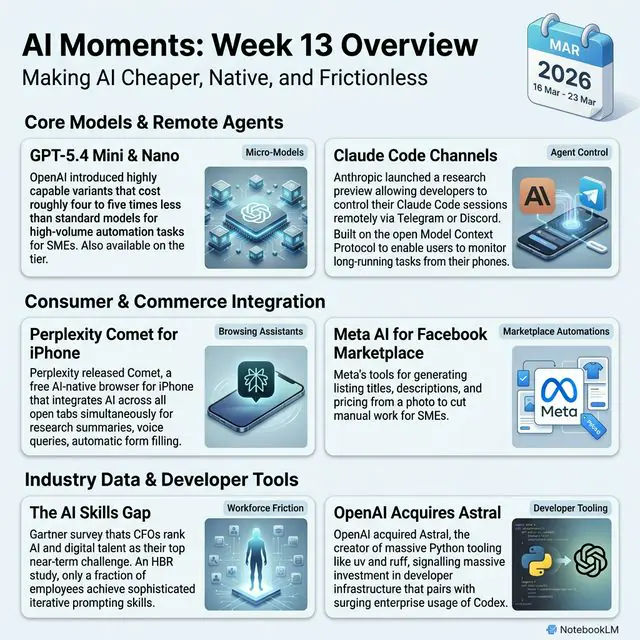
Research Period: 16 March to 23 March 2026
1. OpenAI releases GPT-5.4 mini and nano — capable AI models at a fraction of the cost
What changed
OpenAI has launched two smaller variants of GPT-5.4. Mini costs $0.75 per million input tokens and $4.50 per million output tokens — roughly four to five times cheaper than standard models, and twice as fast. Nano comes in at $0.20 per million input tokens for high-volume, simpler tasks. Mini also gets a 400k context window.
Why it matters
Cost has been the main reason SMEs hold back from using AI beyond the occasional chat. These models change the maths entirely. One million tokens is roughly 750,000 words of input. At $0.75 per million, summarising a document or classifying a customer enquiry costs fractions of a penny. Simon Willison demonstrated this nicely: he narrated 76,000 photos for $52 using mini-class models. For guild members who are developing processes with routine tasks, this is good news and is continuing to make AI more universally accessible.
How to use it
- Try GPT-5.4 mini — look for the Thinking feature and start with document summaries or drafting tasks
- Test existing API automations to see if they can be switched to gpt-5.4-mini to cut costs 4–5× without significant quality loss on routine tasks
- Evaluate gpt-5.4-nano for high-volume work like categorising enquiries, extracting data from invoices, or tagging inventory
- Estimate your monthly AI usage and calculate the cost at $0.75 per million tokens — for most SMEs it will be single-digit pounds per month
- Use the cost savings to experiment more freely — run tasks you previously considered too expensive to automate
Source: Simon Willison’s analysis | OpenAI announcement
Note: GPT-5.4 base model was covered in last week’s newsletter. Mini and nano are separate lower-cost variants with fundamentally different pricing and free-tier access.
2. Anthropic ships Claude Code Channels — control your coding AI agent from Telegram or Discord
What changed
Anthropic has launched Claude Code Channels as a research preview. It lets developers send instructions to a running Claude Code session from Telegram or Discord while away from their desk. It’s built on MCP (Model Context Protocol), the open standard Anthropic introduced for connecting AI tools. The session retains full filesystem, git, and tool access, so you’re genuinely controlling the agent, not just chatting with it. You’ll need a Claude Pro or Max subscription.
Why it matters
If you use Claude Code for development or automation, you’ve had to be at your desk to interact with it. Channels removes that constraint. You can check on a long-running task from your phone, approve a step while you’re in a meeting, or kick off a new job on your commute. VentureBeat called it an “OpenClaw killer” — a sign of how seriously the industry is taking remote agent control. For SMEs running overnight automations or deploying code outside office hours, this is a practical quality-of-life improvement.
How to use it
- Update your Claude Code installation and follow the Channels setup guide at code.claude.com to configure the MCP server
- Set up the Telegram integration first — it has the most community documentation and takes about 15 minutes
- Test with a simple task: start a Claude Code session, step away from your desk, and send an instruction from your phone to confirm the connection works
- Use Channels to monitor long-running automated tasks on your commute rather than leaving a terminal open all day
- Explore triggering new tasks remotely — useful if you run automations overnight or want to check in on deployments
Source: Claude Code Docs | VentureBeat
3. Perplexity’s Comet AI browser launches on iPhone — AI across every tab
What changed
Perplexity has released Comet, an AI-powered browser for iPhone. Unlike bolting an AI chatbot onto a standard browser, Comet’s assistant works across all your open tabs simultaneously. It can answer questions about the page you’re reading, respond to voice queries, and help fill in forms. A Pro tier at $20/month adds extra features and provides business-appropriate data handling. iPhone only for now — it joins existing Mac, Windows, and Android versions.
Why it matters
Most people still experience AI through a separate app: open ChatGPT, paste something in, get a response, switch back. Comet removes that friction by putting AI inside the browser itself. If you spend a good chunk of your day researching suppliers, reading industry news, or filling in repetitive web forms, having AI available without switching apps adds up.
How to use it
- Download Comet from the App Store and use it for your next research session — ask it to summarise long articles as you browse
- Test the voice mode during your commute: get spoken summaries of saved pages while travelling
- Try the form-filling assistance for repetitive web tasks — supplier applications, directory listings, standard enquiry forms
- Compare researching a topic in Comet against using Safari and ChatGPT separately — the reduced context-switching is noticeable
- Keep Safari as your default for personal browsing; use Comet specifically for work research to keep data separate
Source: 9to5Mac
Additional Noteworthy Developments
Meta adds AI tools to Facebook Marketplace: Upload a photo and AI generates title, description, and suggested price in about 30 seconds. Automated buyer replies and in-stream shipping labels included, all free. Worth testing for surplus stock — though avoid listing anything with sensitive business data on a consumer platform. | Meta Newsroom
Anthropic launches the Anthropic Institute: A separate body to research AI’s societal impacts and inform policymakers, backed by a $100M partner network and a new Snowflake partnership. | Anthropic
Shopify prepares for AI shopping agents: Merchants can now sell through ChatGPT, Google AI Mode, and Microsoft Copilot as AI-powered shopping channels. Sidekick AI has shifted from reactive to proactive, suggesting actions rather than waiting. | Shopify Blog
NVIDIA GTC 2026 — Unsloth Studio offers no-code model fine-tuning: A web tool for fine-tuning 500+ models without writing code or owning a GPU. Enterprise-positioned for now; watch for SME-accessible pricing. | NVIDIA Blog
OpenAI acquires Astral’s Python developer tools: Astral’s tools (uv, ruff, ty) see 126 million downloads per month. Codex usage has grown 3× in users and 5× in usage since January 2026 — a sign of how fast AI-assisted coding is scaling. | OpenAI Blog
Gartner: CFOs rank AI talent as their #1 near-term challenge. A survey of 100 CFOs found only 36% feel confident driving AI impact. Gartner’s advice: upskill your existing workforce rather than relying on recruitment alone. | Gartner
Worth Knowing
Three recent research findings worth being aware of, even without an immediate action step:
- LLMs use persuasion tactics when challenged. This research suggests that when professionals push back on AI errors, models respond with multiple simultaneous rhetorical tactics rather than reconsidering — a study of 244 BCG consultants found this pattern consistently. | Harvard Business Review
- Only 5% of employees become highly sophisticated AI users. This research suggests the differentiators are ambitious framing, specific prompting, and iterative refinement — and that managers outperform junior staff, contradicting assumptions about younger workers being naturally better with AI. | Harvard Business Review
- LLMs produce generic strategic advice. This research suggests that when asked for business strategy, leading models almost uniformly select the same trendy approaches regardless of context — the researchers call it “trendslop.” Use AI to expand your options, not to generate your final direction. | Harvard Business Review
Looking Ahead
The pattern this week is clear: capable AI is getting cheaper and more accessible. Costs that were a genuine barrier six months ago are now negligible for most SME use cases, and AI tools are finding their way into more everyday workflows — from coding environments to browsers. Expect competitors to respond with their own pricing moves over the coming weeks.
This briefing focuses on AI developments relevant to SME operations, emphasising practical applications in productivity, cost efficiency, and business capability.