
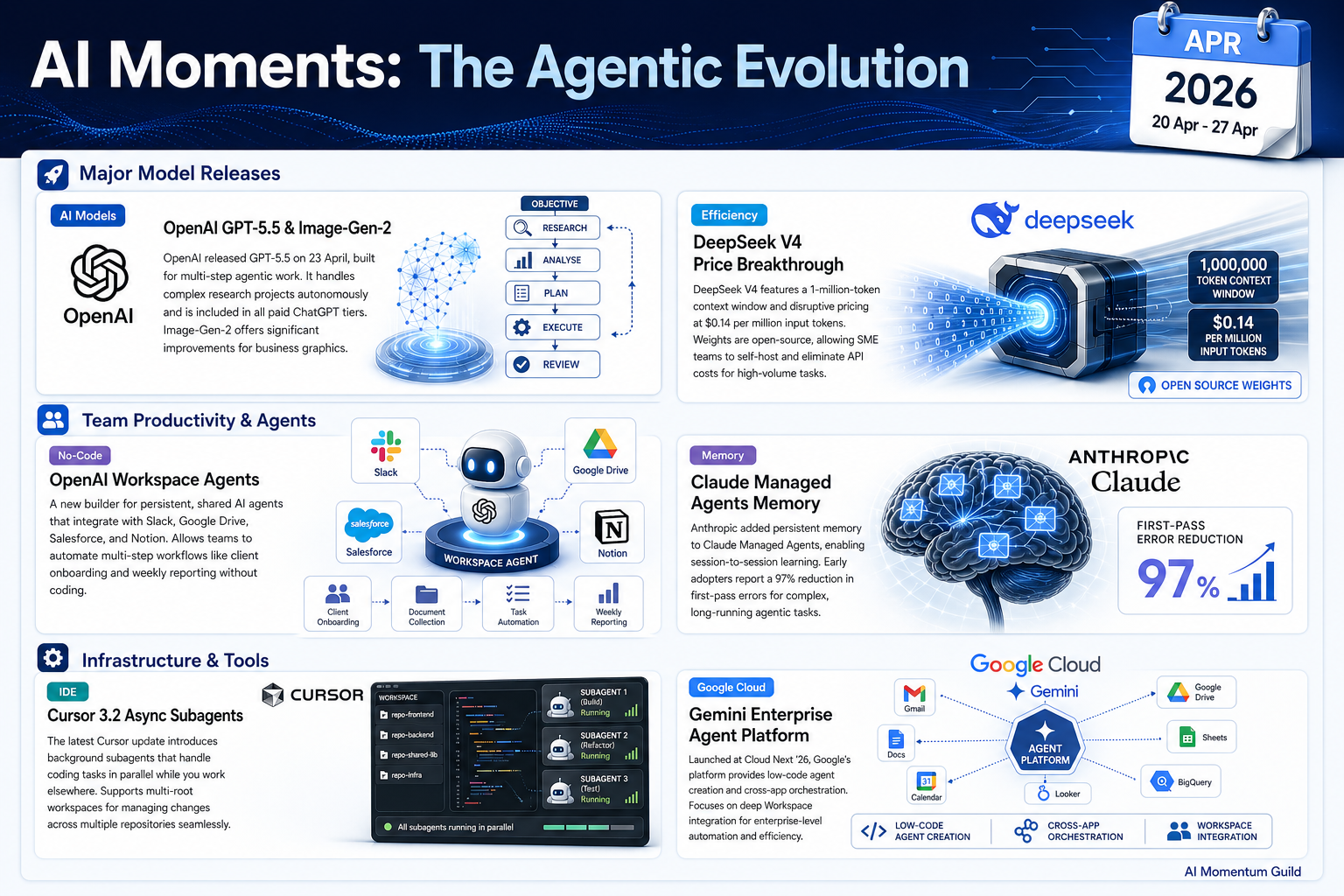
Research Period: 20 April – 27 April 2026
1. OpenAI launches GPT-5.5 & Image-Gen-2 — the most capable ChatGPT model yet, now in all paid plans
What changed
OpenAI released GPT-5.5 on 23 April, and it’s already available across every paid ChatGPT tier — Plus, Pro, Business, and Enterprise — at no extra cost. Higher tiers also get GPT-5.5 Thinking and GPT-5.5 Pro variants for the heaviest reasoning tasks. The model is built for agentic work, meaning long, multi-step jobs you can set running and check back on. Image-Gen-2 is also impressing people with its capabilities (especially for business graphics). The API followed on 24 April under the model ID gpt-5.5. Ethan Mollick called it “a sign of the future” and a clear signal that the pace of AI improvement isn’t slowing down.
Why it matters
If you’re paying for ChatGPT, you’ve just had a meaningful upgrade without lifting a finger. GPT-5.5 handles tasks that previously needed constant re-prompting: think research projects you can hand off and come back to in 20 minutes with a draft ready. For an SME owner, that’s the difference between using ChatGPT as a clever search box and using it as a junior team member you can delegate to. Worth spending an hour this week deliberately testing it on something more ambitious than usual.
How to use it
- Run multi-step research: prompt it to investigate a topic, summarise findings, and draft a report in one go
- Tackle workflows that previously needed constant re-prompting; set it going and check back later
- Use Image-Gen-2 to create business graphics (infographics, presentations, social media posts, etc.)
- Use it for coding assistance if you have developers on the team
- Analyse and compare long documents (contracts, supplier proposals, pricing sheets)
Source: TechCrunch coverage | Ethan Mollick analysis
2. OpenAI launches Workspace Agents — no-code shared AI agents your whole team can use
What changed
OpenAI’s new Workspace Agents let you describe a job in plain English and build a persistent AI agent that the whole team can use. They keep running after you close your laptop and integrate with Slack, Google Drive, the Microsoft suite, Salesforce, Notion, and Atlassian Rovo. Think of them as the grown-up successor to Custom GPTs: long-running, team-accessible, and properly plugged into your existing tools. It’s currently a research preview, available for ChatGPT Business and Enterprise plans, and credit-based pricing kicks in after 6 May 2026. You have to contact sales to get access.
Why it matters
This is the first credible no-code agent builder for small teams. Until now, building a shared AI workflow meant either a developer with API keys or stitching together Zapier-style automations. Workspace Agents collapses that into a description and a few clicks. The catch: you need a ChatGPT Business, Enterprise, Edu, or Teachers plan. Plus subscribers ($20/month) are not eligible. If you’re already on Business, this is the most interesting thing OpenAI has shipped for SME teams in months.
How to use it
- Build a client onboarding agent that pulls CRM data and drafts a welcome pack
- Create a weekly report agent that synthesises activity across Slack, Notion, and Google Drive
- Set up a daily briefing agent that surfaces and summarises useful information daily from your tools
- Build a customer enquiry triage agent that categorises and drafts responses from your inbox
- Create a meeting prep agent that summarises relevant background before a client call
Worth noting: this is a research preview, so rollout may not be globally instant. Set yourself a reminder before 6 May to review the credit-based pricing before the free period ends.
Source: VentureBeat analysis | OpenAI announcement
3. DeepSeek launches V4 with 1M token context and the lowest frontier pricing to date
What changed
Chinese AI lab DeepSeek released V4 on 24 April in two flavours: V4 Flash and V4 Pro. The headline numbers are striking. V4 Flash costs $0.14 per million input tokens and $0.28 per million output, roughly an order of magnitude below comparable models from OpenAI or Anthropic. Both versions handle a 1-million-token context window, meaning entire contracts or product catalogues fit in a single prompt. The weights are open-source on Hugging Face, so technically capable teams can self-host.
Why it matters
Most guild members won’t use DeepSeek directly, but the pricing pressure it creates affects everyone. Expect Anthropic and OpenAI to respond on cost over the coming months. There’s also a real data sovereignty issue: DeepSeek is a Chinese company, and using the API sends your data to Chinese servers. For confidential client work or regulated sectors, that’s a non-starter; use the self-hosted open-source version or stay with UK/EU-compliant providers. For non-sensitive tasks, the API may be fine, but worth a conscious decision rather than a default.
How to use it
- API developers: benchmark V4 Flash at $0.14/M tokens against your current LLM costs for high-volume tasks
- Self-host the open-source weights to eliminate API costs for suitable workloads
- Process very large documents in a single pass without splitting and stitching
- Use the pricing as a competitive reference when negotiating SaaS AI tool costs
- Developers: the 1M context window unlocks tasks that previously required complex chunking
Source: DeepSeek release notes | CNBC analysis
Additional Noteworthy Developments
Anthropic adds persistent memory to Claude Managed Agents: Memory is now in public beta for Claude Managed Agents API users. Agents can remember across sessions and share learnings; early adopters report 97% fewer first-pass errors. Developer access required. | SD Times | i-scoop
Anthropic briefly removed Claude Code from Pro, then reversed within 24 hours: Anthropic tested removing Claude Code from the £20/month Pro tier on 21 April. Community pushback led to a reversal by 23 April. Claude Code stays on Pro for now, but pricing changes are likely ahead. | Where’s Your Ed At
Cursor 3.2 ships async subagents and multi-root workspaces: Cursor’s update adds agents that run in the background while you work elsewhere, plus better support for managing changes across multiple repositories in one session. Incremental but useful for parallel feature work. | Cursor changelog
Google Cloud Next ’26: Gemini Enterprise Agent Platform launches: Google announced its enterprise agent builder at Cloud Next (22–24 April), with low-code agent creation, cross-app orchestration, and deeper Workspace integration. Enterprise-focused; expect Workspace Business features to follow. | Google blog
Looking Ahead
Amazon committed a further $5B to Anthropic this week (total now nearing $20B; valuation $350B), confirming Claude is here for the long haul. Separately, an HBR piece argues businesses must consider how they appear to AI agents that increasingly shortlist vendors. Try asking ChatGPT “Who should I hire for [your service]?” and see what comes up.
This briefing focuses on AI developments relevant to SME operations.