
Research Period: 13 April – 20 April 2026
1. Anthropic launches Claude Design — and the design software market takes notice
What changed
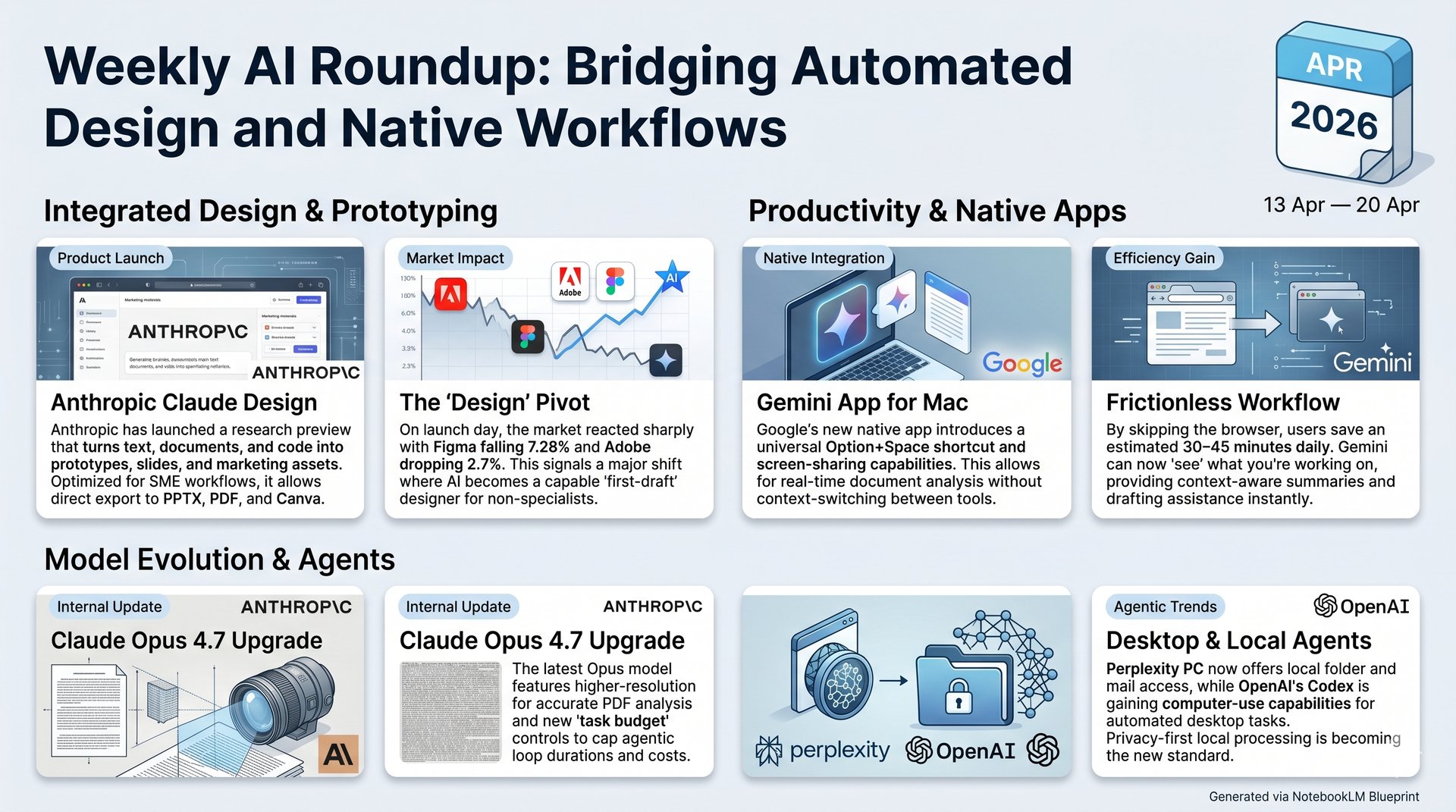
On 17 April, Anthropic launched Claude Design, a research preview that turns text descriptions, uploaded documents, or codebases into prototypes, presentation slides, landing pages, and marketing assets. It’s powered by Claude Opus 4.7 and included at no extra cost for Pro, Max, Team, and Enterprise subscribers. On launch day, Figma shares fell 7.28% and Adobe dropped 2.7%: the market clearly sees this as material.
Why it matters
If you’re already paying for Claude, you’ve just acquired a capable first-draft design tool. Think of it as having a junior designer on call: not a replacement for a brand specialist, but perfectly adequate for the pitch deck, one-pager, or landing page you’d otherwise sketch in Canva or farm out to a freelancer. Exports run to PDF, PPTX, Canva, or standalone HTML, so you can refine in whatever tool your team already uses. Expect to save 2–5 hours per week if you produce marketing materials regularly.
How to use it
- Draft a 10-slide pitch deck from a company overview document in minutes rather than hours.
- Generate a landing page prototype from a text brief to test an offer with clients.
- Produce branded one-pagers for services, then export to Canva for fine-tuning.
- Turn an internal strategy document into slides for the next team meeting.
- Build interactive prototypes to show a developer what you actually want built.
Source: Anthropic Blog | TechCrunch
2. Google releases a native Gemini app for Mac
What changed
Google launched a native macOS app for Gemini on 15 April. The headline feature is Option+Space: hit it anywhere and a mini chat overlay pops up without swapping to a browser tab. You can share your screen so Gemini sees what you’re working on, plus image and video generation are included. It needs macOS 15 or later. Paid plans are Google AI Plus at $7.99/month and Pro at $19.99/month.
Why it matters
The productivity win is specific: about 30–60 seconds saved per AI interaction by skipping the browser context switch. If you use AI 20–30 times a day, that’s 30–45 minutes back daily. Screen sharing is the more interesting capability: Gemini can review a document you’re drafting or an email you’ve written without copy-paste. One caveat: Google’s announcement says “all Gemini users”, but Google Workspace business accounts have separate entitlements. If you’re a Workspace customer, check what your plan actually includes before assuming paid-tier features apply. The AI Plus plan at $7.99/month is the business-appropriate tier for most SMEs.
How to use it
- Pop Gemini open with Option+Space whilst drafting to get a second opinion on phrasing.
- Share your screen so Gemini can review a spreadsheet or presentation in context.
- Generate images for social posts without leaving the app you’re working in.
- Ask Gemini to summarise a document you have open rather than uploading it afresh.
- Use the overlay during client calls to quickly look up figures or draft follow-up notes.
Source: Google Blog | TechCrunch
3. Anthropic releases Claude Opus 4.7 with better vision and agentic controls
What changed
Claude Opus 4.7 shipped on 16 April with three practical improvements: higher-resolution vision (bigger images analysed more accurately), better handling of complex agentic and coding workflows, and a new task budget parameter to limit how long agentic loops run. It’s live across the API, Amazon Bedrock, Google Cloud Vertex AI, and Microsoft Foundry. Pricing is unchanged and there are no geographic restrictions.
Why it matters
If you’re on Claude Pro, Max, Team, or Enterprise, you’re already using it: no action needed. The vision upgrade is the most immediately useful change. Dense PDFs, technical diagrams, product photos, and complex spreadsheets come out the other side with noticeably better accuracy. For anyone using Claude to summarise scanned documents or analyse product imagery, this is a quiet but real quality improvement. Developers get a practical safeguard with task budgets, useful for controlling cost on long agent runs.
How to use it
- Upload a dense technical PDF and ask for a plain-English summary with specific figures extracted.
- Analyse a product photograph and generate accurate specifications or descriptions.
- Feed in a scanned invoice or receipt and extract line items with fewer errors.
- Review a complex diagram or flowchart and convert it into a written process document.
- Developers: set task_budget on agentic API calls to cap runtime and cost predictably.
Source: Anthropic Release Notes | GitHub Changelog
Additional Noteworthy
Perplexity Personal Computer on Mac: Perplexity’s Mac assistant can now access local folders, iMessage, Apple Mail, and Calendar without cloud processing — a privacy-first alternative to cloud agents. Max subscription required (~$40/month). | 9to5Mac
Claude Code Routines: Anthropic launched scheduled automations for Claude Code that run in the cloud without your machine online. Pro gets 5 runs/day, Max gets 15. Technical members only. | 9to5Mac
OpenAI Codex gains computer use: Codex on Mac can now click, type, and scroll across any app, plus 90+ new plugins and persistent memory. Computer use is not available in the UK or EU yet — watch for rollout. | OpenAI Blog
Gemini personalised image generation: Google is rolling out image generation that draws on your Google Photos library. Currently US-first; UK and EEA availability not confirmed. | Google Blog
Notion Workers for Agents: Notion 3.4 adds a developer preview letting Notion’s AI call JavaScript/TypeScript functions to query CRMs and push data — no Zapier or Make needed. 30s timeout in preview. | Notion Release Notes
Looking Ahead
Two items worth noting for context. HBR argues that staff quietly using personal ChatGPT alongside corporate systems aren’t just a compliance risk — they’re signalling unmet demand (HBR). A useful reframe: ask your team what they’re trying to accomplish with the tools they’ve found on their own, then support it properly. Separately, OpenAI launched GPT-5.4-Cyber for verified security teams only (Axios) — not accessible to general SMEs, but a signal that frontier labs are now competing hard for specialist security customers.
This briefing focuses on AI developments relevant to SME operations. For the interactive slide version and infographic, see the links at the top.